Could Your Snoring Be Sleep Apnea? Ask Your Dentist
You might not think of your dentist as the first person to ask about snoring. But a sleep apnea dentist is often the first clinician to notice the oral signs of obstructive sleep apnea, sometimes years before a patient gets a formal diagnosis. The National Institutes of Health estimates that up to 80% of moderate-to-severe obstructive sleep apnea cases go undiagnosed, which means millions of Americans are living with fragmented sleep and don't know why.
At Willow Family Dentistry in Wylie, TX, Dr. Esther Jeong includes a sleep-disordered breathing assessment as part of her thorough exam. This article explains what she looks for, how snoring relates to sleep apnea, and what your next steps look like if something comes up.
What Does a Sleep Apnea Dentist Actually Look For?
A dentist trained in sleep-disordered breathing looks for physical signs inside your mouth and jaw that suggest your airway may be partially collapsing during sleep. These signs include a scalloped tongue, worn-down teeth, a narrow palate, and specific patterns of soft tissue crowding at the back of the throat.
Here's why your dentist sees these clues before anyone else. You open your mouth at every dental visit. That gives Dr. Jeong a direct view of the structures that affect your airway: the size and position of your tongue, the width of your palate, the condition of your tonsils, and whether your jaw sits further back than normal (a trait called retrognathia). None of these things show up at a typical annual physical.
Tooth wear is one of the biggest tip-offs. People with obstructive sleep apnea frequently grind their teeth at night, a condition called bruxism. The brain triggers clenching as a way to tighten the airway muscles and keep breathing. Over time, that grinding flattens the biting surfaces of your teeth, cracks enamel, and can even fracture dental crowns. If Dr. Jeong sees wear patterns that don't match your age or habits, she'll ask about your sleep quality.
A scalloped tongue is another marker. When the tongue is too large for the oral cavity or the jaw is too narrow, the tongue presses against the teeth during sleep and develops ridged indentations along its edges. That scalloping tells Dr. Jeong the tongue is likely falling back into the airway at night.
How Is Snoring Connected to Sleep Apnea?
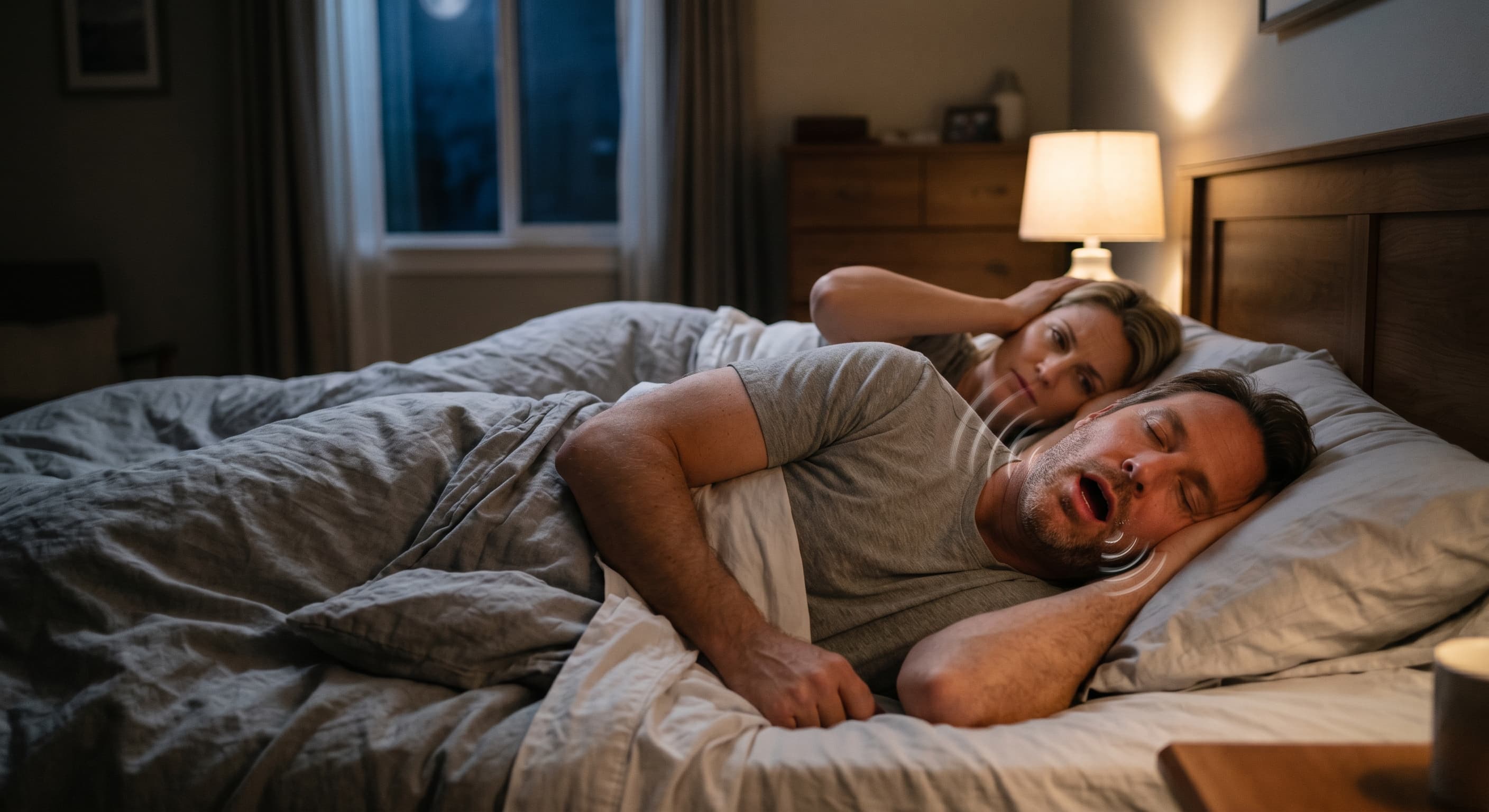
Snoring is the sound of partially obstructed airflow through relaxed throat tissues. It's common, and it doesn't always mean you have sleep apnea. But loud, chronic snoring is the single most reported symptom of obstructive sleep apnea, and the two conditions share the same underlying cause: a narrowed airway.
Not all snoring is the same. Occasional snoring after a late meal or a glass of wine is normal. Nightly snoring that's loud enough to wake your partner, interrupted by pauses in breathing, and followed by gasping or choking sounds is a different story. Those pauses are apneas, moments where the airway fully closes and your blood oxygen drops until the brain jolts you awake just enough to resume breathing. Most people don't remember these arousals. They just feel exhausted in the morning.
The risk factors overlap significantly. A narrow jaw, large neck circumference (17+ inches for men, 16+ for women), excess weight around the throat, and age over 40 all increase the likelihood that snoring crosses the line into obstructive sleep apnea. According to a study cited by the Mayo Clinic, men are two to three times more likely to have OSA than premenopausal women, though the gap narrows after menopause.
Here's the piece many people miss: you don't have to be overweight to have sleep apnea. Skeletal anatomy plays a huge role. A person with a recessed jaw and narrow palate can have significant airway obstruction at a perfectly healthy weight. That's exactly the kind of anatomy a sleep apnea dentist is trained to evaluate.
Related: Sleep apnea and cardiovascular risk are closely linked. → Gum Disease and Heart Disease: What Your Dentist Knows
What Happens During a Sleep-Disordered Breathing Assessment?
At Willow Family Dentistry, the sleep-disordered breathing assessment is a focused evaluation of your airway, bite, and sleep symptoms. It happens during or alongside a routine exam, takes about 15 minutes, and doesn't require any special equipment beyond what's already in the operatory.
Dr. Jeong starts with a visual airway evaluation. She'll check your Mallampati score, which is a classification of how much of the back of your throat is visible when you open your mouth wide. A higher score (Class III or IV) means the tongue and soft tissues are crowding the airway, which correlates with higher apnea risk. She'll also look at tonsil size, the position of your soft palate, and the width of your dental arches.
Next, she'll review your bite. Signs like worn enamel, fractured restorations, or evidence of clenching point toward nocturnal bruxism, one of the most common co-occurring conditions with OSA. She may also use the iCAT 3D imaging system to get a clearer view of your airway dimensions if warranted.
Then comes the conversation. Dr. Jeong will ask targeted questions based on validated screening tools like the Epworth Sleepiness Scale and the STOP-BANG questionnaire. Do you feel tired during the day even after a full night's rest? Has your partner noticed you stop breathing at night? Do you wake up with headaches or a dry mouth? These are the questions that connect what she sees in your mouth to what's happening while you sleep.
If the assessment suggests a significant risk for OSA, Dr. Jeong will refer you to a board-certified sleep physician for a formal diagnosis. That usually means a home sleep test (a small device you wear for one or two nights) or an in-lab polysomnography. She doesn't diagnose sleep apnea herself. What she does is identify the patients who need to be evaluated and make sure they actually get there.
Wondering About Your Sleep Quality?
Dr. Jeong includes a sleep-disordered breathing assessment as part of every thorough exam. Mention your snoring at your next visit.
Request an Appointment →Can a Dentist Treat Sleep Apnea?
Yes, dentists can treat mild-to-moderate obstructive sleep apnea with custom oral appliances that hold the lower jaw slightly forward during sleep, keeping the airway open. These devices are called mandibular advancement devices, and both the ADA and the American Academy of Sleep Medicine recognize them as a first-line alternative to CPAP.
A CPAP machine works well for severe OSA, but adherence is a real challenge. Research published in the Journal of Clinical Sleep Medicine has shown that roughly 50% of patients prescribed CPAP stop using it consistently within the first year. The mask, the noise, the hose, the dry air, the claustrophobia. It's a lot. For patients with mild-to-moderate OSA who can't tolerate CPAP, an oral appliance offers a simpler solution.
The device looks similar to an orthodontic retainer. It's custom-fitted to your teeth and calibrated so that it moves the mandible (lower jaw) forward by a specific number of millimeters. That forward positioning pulls the base of the tongue away from the back of the throat and tightens the soft tissue around the airway. The result: less collapse, less obstruction, fewer apneas.
Not everyone qualifies. Oral appliance therapy works best for patients diagnosed with mild-to-moderate OSA (an AHI score of 5-30 events per hour) who have adequate dentition to anchor the device. Patients with severe OSA or significant central sleep apnea typically need CPAP or a combination approach. Dr. Jeong coordinates with your sleep physician to determine which treatment path makes sense for your specific diagnosis.
Related: Nervous about dental visits in general? Sedation can help with that too. → Sedation Dentistry Wylie TX: Your Options Explained
Why Does Sleep Apnea Matter for Your Oral Health?
Obstructive sleep apnea doesn't just wreck your sleep. It accelerates oral health problems through a combination of bruxism, chronic dry mouth, and increased inflammation. The relationship runs both directions: poor oral health can worsen sleep apnea, and untreated apnea can damage your teeth and gums.
Bruxism is the most visible connection. As mentioned earlier, the brain triggers jaw clenching to keep the airway open during apnea events. Over months and years, that clenching grinds down enamel, loosens crowns, and creates micro-fractures in teeth that eventually need restorative treatment. If you've been told you grind your teeth but a night guard hasn't solved the problem, sleep apnea could be the underlying cause.
Dry mouth is the second issue. Mouth breathing during sleep (common in OSA patients) dries out the oral tissues and reduces saliva flow. Saliva is your mouth's primary defense against cavities and gum disease. Without it, bacteria thrive. The ADA notes that chronic dry mouth significantly increases cavity risk and can contribute to persistent bad breath.
Then there's the inflammation loop. Obstructive sleep apnea triggers systemic inflammation through repeated drops in blood oxygen. That inflammatory response has been linked to accelerated periodontal disease progression. The CDC reports that 42% of adults over 30 already have some form of gum disease. Add untreated sleep apnea to the mix, and the risk of bone loss and tooth loss climbs higher.
Your Oral Health and Sleep Are Connected
If you're grinding your teeth, waking up with dry mouth, or dealing with unexplained dental problems, a sleep-disordered breathing assessment can help identify the root cause.
Request an Appointment →When Should You Bring Up Snoring With Your Dentist?
Bring it up at your next visit. Seriously. Most patients never mention snoring to their dentist because it doesn't feel like a "dental" issue, but it's one of the most valuable things you can share. Even if it turns out to be nothing, the conversation takes two minutes and could change the trajectory of your health.
You should be especially proactive if you recognize three or more of these warning signs: loud snoring most nights of the week, daytime fatigue or sleepiness despite getting 7-8 hours in bed, morning headaches that fade within an hour or two, waking up with a dry mouth or sore throat, a bed partner who has witnessed you stop breathing or gasp during sleep, difficulty concentrating or unexplained irritability, and high blood pressure that's hard to control with medication.
None of those symptoms alone confirms sleep apnea. But together, they paint a picture that's worth investigating. According to the American Academy of Sleep Medicine, untreated obstructive sleep apnea is associated with a two to three times higher risk of hypertension and significantly higher risk for stroke, Type 2 diabetes, and cardiac events. This isn't just a snoring problem. It's a systemic health risk.
Dr. Jeong's team makes it easy. You can mention snoring during your next routine visit or bring it up when you schedule. Either way, it gets documented, evaluated, and addressed. The worst outcome is peace of mind. The best outcome is catching a condition that's been affecting your sleep, your energy, and your health for years.
Related: Not sure how often you should be visiting the dentist? → How Often Should You Go to the Dentist?
Your dentist sees the inside of your mouth more often than any other healthcare provider. That makes the dental chair one of the best places to catch the early signs of obstructive sleep apnea, often before symptoms become severe enough to send you to a sleep clinic on your own. A sleep apnea dentist isn't replacing your physician. She's adding a layer of screening that most people don't even know exists.
If you snore, grind your teeth, or wake up feeling like you didn't sleep at all, mention it at your next appointment with Dr. Jeong at Willow Family Dentistry. The assessment is quick, it's part of your regular visit, and it could be the starting point for finally getting the rest you've been missing.
Sleep Better. Start at the Dentist.
Dr. Jeong evaluates every patient for sleep-disordered breathing. Schedule your visit and mention your snoring. It could change everything.
Request an Appointment →Want to talk to someone before booking?
Call (972) 881-0715 →Dr. Esther B. Jeong, DDS
DDS · Willow Family Dentistry
Wylie family dentist with 15+ years of experience providing gentle, judgment-free dental care.
Frequently Asked Questions
Was this article helpful?
Have a dental question?
Schedule a consultation and get personalized answers from Dr. Jeong.
Call us
(972) 881-0715
Hours
Mon – Thu: 9am – 5pm
Fri: By Appointment
Location
1125 W FM 544, Wylie
Emergency? Same-day appointments available.