Root Canal Cost Wylie TX: 2026 Pricing by Tooth Type

Root canal cost in Wylie TX depends primarily on which tooth needs treatment because the number of canals inside each tooth type directly determines treatment time, complexity, and fee. A front tooth with one canal takes 45 minutes. A molar with three or four canals takes 60-90 minutes, since each canal must be located, cleaned, shaped, and sealed individually, and requires significantly more instrumentation. Dr. Esther Jeong at Willow Family Dentistry performs root canals in-house without specialist referral, which means one office, one fee schedule, and no surprise billing from an unfamiliar endodontist. This guide gives you the exact pricing framework so you can budget before you call.
Root Canal Cost Wylie TX: 2026 Price by Tooth Type
| Tooth Type | Canals | Relative Root Canal Fee | Crown Needed? | Relative Total |
|---|---|---|---|---|
| Front tooth (incisor/canine) | 1 | Lowest (single canal) | Usually recommended | Lowest overall |
| Premolar (bicuspid) | 1-2 | Moderate (1-2 canals) | Usually recommended | Moderate overall |
| Molar (back tooth) | 3-4 | Highest (3-4 canals) | Recommended | Highest overall |
These prices reflect 2026 DFW market rates for in-house root canal treatment at a general dentist. An endodontist (root canal specialist) in the Dallas area charges 20-40% more for the same procedure because specialty offices have higher overhead and the referral adds a separate facility fee. Dr. Jeong performs routine root canals in-house, saving patients both the specialist markup and the inconvenience of visiting a separate office. According to the ADA Health Policy Institute, root canal fees have increased approximately 3-5% annually since 2022, driven primarily by staffing costs and materials pricing.
That said, where you have your root canal done affects more than cost. Many general dentists, including Dr. Jeong at Willow, perform routine root canals in-house, which spares you a separate referral, a new set of records, and a second office visit. More complex cases, such as a molar with unusual canal anatomy or a retreatment, are still best referred to a specialist, and a good general dentist will tell you honestly which category your tooth falls into.
What Does Insurance Pay Toward a Root Canal?
Most dental insurance plans classify root canals as "basic" (anterior teeth) or "major" (premolars and molars) restorative treatment. The coverage structure varies by plan but follows a common framework.
| Component | Total Fee | Insurance Pays | Your Out-of-Pocket |
|---|---|---|---|
| Molar root canal (in-network) | Standard fee | 50-80% after deductible | Remaining balance |
| Porcelain crown (in-network) | Standard fee | About 50% | Remaining balance |
| Core buildup (if needed) | Added when needed | About 50% | Remaining balance |
| Total molar root canal + crown | Combined fee | Majority covered (in-network) | Your remaining share |
Important plan variables that shift your number. Annual deductible applies to the first non-preventive claim of the year. If you've already met your deductible from other treatment, it doesn't apply again. An annual maximum caps the total the plan pays per year.
This is why timing can matter. If your treatment falls near the end of a benefit year, splitting it across two years, the root canal now and the crown in January, can let you use two annual maximums instead of one. Willow's team can help you sequence treatment around your benefits so you capture the most coverage available, which is one of the simplest ways to lower what you actually pay. If you've already used most of your annual maximum earlier in the year, only the remaining balance is available for the root canal. Waiting periods on individual plans (not employer plans) may impose a 6-12 month delay before major procedures are covered.
Dr. Jeong's team submits a pre-treatment estimate to your insurance before scheduling the root canal. The estimate returns the exact dollar amount the plan will pay and the exact amount you owe, line by line. According to the ADA, pre-treatment authorization eliminates the billing surprise that makes patients avoid necessary treatment.
Related: Full step-by-step procedure guide. → Root Canal Procedure: What Happens Step by Step
Why Does a Molar Root Canal Cost More Than a Front Tooth?
The fee difference isn't arbitrary. It directly reflects treatment complexity and time.

A front tooth (incisor or canine) has one canal that runs straight down a single root. The canal is wide, easy to access, and straightforward to clean and fill. Treatment time: 45-60 minutes. One file sequence. One canal to seal.
A molar has three to four canals distributed across two or three roots. The canals are narrower, often curved, and sometimes calcified. Locating all canals, navigating curved anatomy, and achieving a thorough seal in each requires multiple file sequences, more irrigation, more imaging, and more time. Treatment time: 60-90 minutes. According to the AAE, missed canals are the leading cause of root canal failure, and molars have the highest rate of accessory canals and complex anatomy that demands careful identification.
Dr. Jeong uses the iCAT 3D scan to map canal anatomy before starting the root canal. The scan shows how many canals are present, whether they're curved, and whether calcification will complicate access. This pre-operative planning reduces treatment time and increases success rates, which is why Willow's in-house root canal results compare favorably to specialist outcomes for routine cases.
Do You Always Need a Crown After a Root Canal?
Almost always for premolars and molars. These teeth bear heavy chewing forces, and a root-canal-treated tooth is more brittle because the pulp (blood supply) has been removed. Without a crown, the tooth is vulnerable to fracture under chewing load, which would require extraction and a more expensive implant replacement; a cracked or broken tooth is one common way this happens.
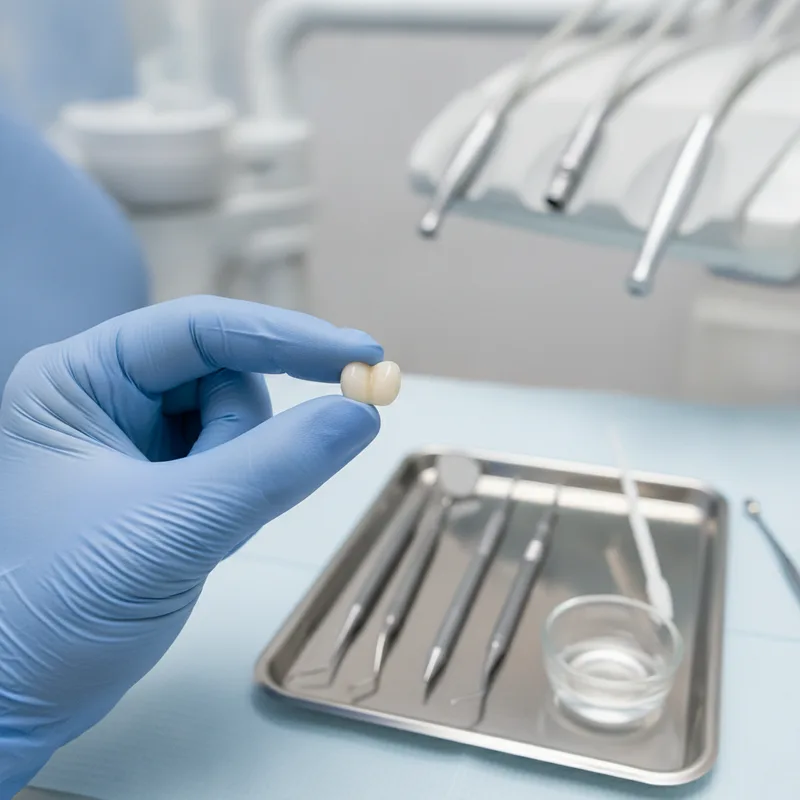
Front teeth are the exception in some cases. If the front tooth has minimal structural loss (small access hole, no large filling, no fracture), Dr. Jeong may recommend a composite filling to seal the access hole rather than a full crown. This avoids the separate crown cost entirely.
The reason a crown matters so much after a back-tooth root canal comes down to biomechanics. A treated tooth loses its internal blood supply and becomes more brittle over time, and molars absorb the heaviest chewing forces in your mouth. A crown caps and protects that weakened tooth, dramatically lowering the risk of a fracture that would otherwise send the tooth to extraction. Skipping the crown to save money short-term is one of the most common reasons a successful root canal fails later. According to the Mayo Clinic, the crown decision is based on remaining tooth structure and functional loading, not a blanket rule. Dr. Jeong evaluates each tooth individually.
Root Canal vs Extraction: The Cost Comparison That Matters
Patients considering whether the root canal investment is "worth it" should compare the full cost of each pathway, not just the procedure fee.
| Pathway | Relative Cost | Timeline |
|---|---|---|
| Root canal + crown (save the tooth) | Lower (saves the tooth) | 2-3 weeks (root canal + crown) |
| Extraction + implant + crown (replace) | Highest (implant replacement) | 4-8 months (extraction + healing + implant + crown) |
| Extraction + bridge (replace) | High (bridge replacement) | 3-4 weeks (requires grinding adjacent teeth) |
| Extraction only (no replacement) | Lowest upfront (but tooth not replaced) | 1 day (but adjacent teeth shift, bone resorbs) |
The root canal is almost always the most cost-effective option when the tooth has a favorable prognosis. It preserves the natural tooth, costs half of an implant replacement, and completes in weeks rather than months. Dr. Jeong recommends based on prognosis, not procedure fee.
How to Pay for a Root Canal Without Insurance
For the roughly one-third of Texas adults without dental insurance, the root canal and crown investment requires planning. Willow offers several pathways.

HSA/FSA accounts cover root canals with pre-tax dollars. Paying for a molar root canal and crown with pre-tax HSA dollars meaningfully lowers the effective cost for Texas patients.
CareCredit and Sunbit financing offers 0% interest for 6-24 months. A typical case financed at 0% over 24 months breaks into a small fixed monthly payment. A shorter 12-month term roughly doubles that monthly amount.
It also helps to weigh the cost of waiting. An infected or cracked tooth rarely improves on its own, and delaying treatment often turns a savable tooth into an extraction, which then needs a far more expensive implant or bridge to replace. Addressing it promptly, even on a payment plan, is usually the most economical path in the long run.
One more option worth asking about is a membership or in-house savings plan. For patients without insurance, these plans typically bundle preventive visits and offer a set discount on treatment like root canals and crowns, which can soften the cost without the paperwork of a traditional insurance claim. Between a savings plan, pre-tax HSA dollars, and 0% financing, most patients find a combination that fits their budget, so cost alone rarely has to stand between you and saving a tooth. The team will walk through every option with you before any treatment is scheduled. No interest means you pay exactly the treatment fee, spread across manageable payments.
Phased treatment splits the root canal and crown across two payment periods. The root canal is completed first (eliminating the infection and pain), and the crown is placed 2-4 weeks later once you've had time to arrange payment. The temporary filling between visits protects the tooth during the interval.
The Willow membership plan provides a percentage discount on root canals and crowns for enrolled patients who don't have traditional insurance.
Need a Root Canal? Know the Cost First.
Dr. Jeong's team submits a pre-treatment estimate showing your exact out-of-pocket cost before scheduling. In-house root canals, no specialist referral, no surprise fees.
Request an Appointment →Root canal cost in Wylie TX depends on the tooth, with the procedure fee plus the crown that protects the treated tooth making up the total.
It helps to think of a root canal as a two-part restoration rather than a single fee. The first part clears the infection and saves the tooth; the second part, the crown, protects it for the long haul. A few cases also need an extra step called a core buildup when too little tooth structure remains to support a crown. Asking for an itemized estimate up front means you understand each component and there are no surprises once treatment is underway. Insurance covers 50-80% of the root canal and 50% of the crown. Without insurance, HSA/FSA, 0% financing, and the membership plan reduce the burden. And the math consistently favors the root canal: saving the tooth today costs roughly half of replacing it with an implant after extraction. Dr. Jeong at Willow Family Dentistry performs root canals in-house, provides exact pre-treatment cost estimates, and offers financing that makes the investment manageable. Call (972) 881-0715 to get your specific number.
Save the Tooth. Know the Cost. No Surprises.
In-house root canals at Willow. Pre-treatment estimate with exact pricing. Insurance verified. 0% financing available. No specialist referral needed.
Request an Appointment →Questions about root canal cost?
Call (972) 881-0715 →Dr. Esther B. Jeong, DDS
DDS · Willow Family Dentistry
Wylie family dentist with 15+ years of experience providing gentle, judgment-free dental care.
Frequently Asked Questions
Was this article helpful?
You may also like



Have a dental question?
Schedule a consultation and get personalized answers from Dr. Jeong.
Call us
(972) 881-0715
Hours
Mon – Thu: 9am – 5pm
Fri: By Appointment
Location
1125 W FM 544, Wylie
Emergency? Same-day appointments available.