Dental Cleaning Cost Wylie TX: What's Included and What's Extra

The dental cleaning cost in Wylie TX is one of the simplest numbers in dentistry and one of the most misunderstood. A standard prophylaxis (routine cleaning) is a modest, routine fee at Willow Family Dentistry, and most insurance plans cover it fully with no out of pocket cost. But the first visit costs more than subsequent visits because new patients need baseline imaging.
And some patients arrive expecting a cleaning but actually need a deep cleaning, which is a different procedure at a different price. This guide separates the numbers so you know exactly what to budget. That full coverage exists for a reason: insurers have learned that routine cleanings are one of the cheapest ways to prevent far more expensive problems, a point echoed by public health guidance on oral health prevention down the road. A cleaning every six months removes the hardened tartar that brushing and flossing can't, and it gives the hygienist and dentist a regular chance to catch early decay or gum changes while they're still small and simple to address.
Dental Cleaning Cost Wylie TX: 2026 Pricing
| Service | ADA Code | Relative Cost | Insurance (PPO) | You Pay |
|---|---|---|---|---|
| Adult prophylaxis (routine cleaning) | D1110 | Standard routine fee | 100% (2x/year) | Typically nothing (covered) |
| Child prophylaxis (under 14) | D1120 | Lower (child) | 100% (2x/year) | Typically nothing (covered) |
| Periodontal maintenance (after deep cleaning) | D4910 | Moderate (perio maintenance) | 80% (varies by plan) | Small share |
| Fluoride treatment (adult) | D1208 | Low add-on | 100% for kids; varies for adults | Varies for adults |
The standard adult prophylaxis (D1110) is what most people mean when they say "dental cleaning." It's covered twice per year on virtually every PPO dental plan with no deductible and no copay. According to the ADA Health Policy Institute, preventive dental visits including cleanings are the most underutilized insured benefit in healthcare. Your premium covers two cleanings per year at no additional cost whether you use them or not.
New Patient First Visit vs Recall Visit: Why the First Costs More
| Component | New Patient Visit | 6-Month Recall Visit |
|---|---|---|
| Exam | Comprehensive (D0150) | Periodic (D0120) |
| X-rays | Full-mouth series or panoramic | 4 bitewing x-rays |
| Cleaning | Prophylaxis (D1110) | Prophylaxis (D1110) |
| Total self-pay | Higher (more included) | Lower |
| Total with insurance | Typically nothing (covered) | Typically nothing (covered) |
| Chair time | 75-90 minutes | 45-60 minutes |
The first visit is more expensive self-pay because Dr. Jeong needs a complete baseline: full-mouth x-rays (14-18 images) or a panoramic radiograph, comprehensive clinical exam, oral cancer screening, gum assessment, and the cleaning itself. Subsequent recall visits are shorter and less imaging-intensive because Dr. Jeong is monitoring changes against the established baseline rather than building one from scratch. Both visit types are 100% covered by insurance as preventive care. According to the ADA, the new patient imaging set is typically covered once every 3-5 years, and bitewing x-rays once every 6-12 months.
The reason your first visit is more involved isn't padding, it's that the practice has no history on you yet. The comprehensive exam and full set of x-rays create a baseline: a complete picture of your teeth, existing work, bone levels, and any developing issues. Every future visit is measured against that baseline, which is what lets the dentist spot small changes over time. At recall visits, you've already got that record on file, so the appointment is shorter and focuses on the cleaning, a periodic exam, and a smaller set of x-rays.
What Does a Standard Cleaning (D1110) Actually Include?
The ADA code D1110, adult prophylaxis, is a specific procedure, not a vague "cleaning." Understanding what's included helps you know what you're paying for.
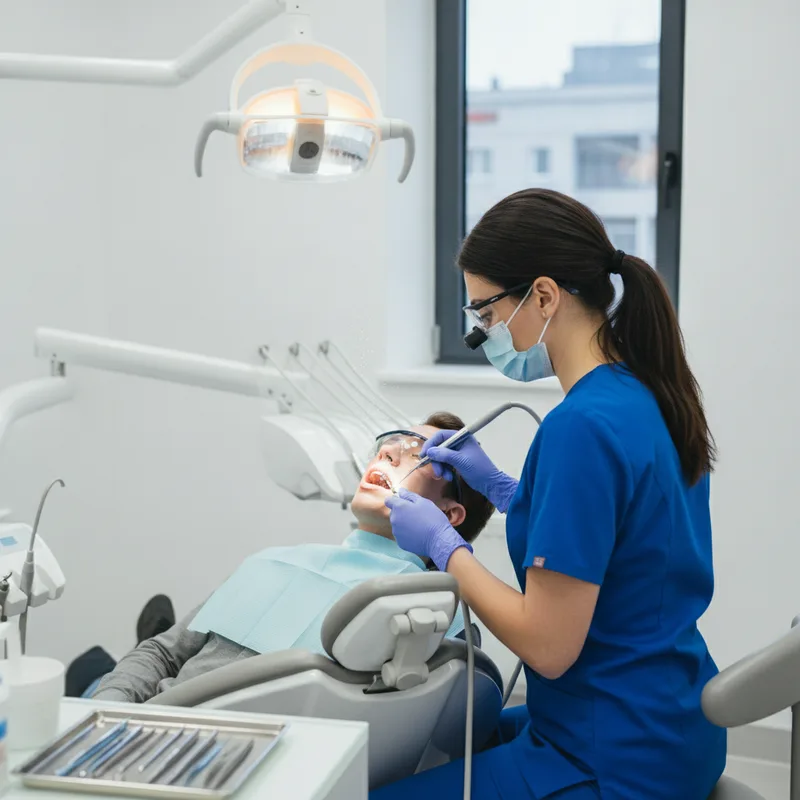
Scaling. The hygienist uses hand instruments (scalers and curettes) and ultrasonic instruments to remove calculus (tartar) and plaque from all tooth surfaces above and slightly below the gumline. Tartar is mineralized plaque that can't be removed by brushing or flossing. It accumulates between visits even with excellent home care. According to the Mayo Clinic, professional scaling removes the hardened deposits that harbor bacteria and drive gum inflammation.
Polishing. A rubber cup with prophylaxis paste (mildly abrasive) polishes all surfaces smooth after scaling. Smooth surfaces resist plaque accumulation better than rough surfaces. Polishing also removes minor surface stains from coffee, tea, and wine.
Flossing. The hygienist flosses between every contact point, checking for areas where the floss catches (indicating rough fillings, overhanging restorations, or early decay) and removing any remaining debris from between teeth.
Oral hygiene assessment. The hygienist evaluates your home care technique, identifies areas you're consistently missing (common: lingual surfaces of lower front teeth, distal surfaces of upper molars), and provides targeted coaching. This personalized feedback is more valuable than any YouTube brushing tutorial because it's based on what your specific mouth actually shows.
A standard prophylaxis is appropriate for patients with healthy gums or mild gingivitis (inflammation without bone loss). Patients with periodontitis (gum disease with bone loss) require scaling and root planing (deep cleaning), which is a different procedure at a different price.
A standard cleaning is part of our preventive dentistry care and is more thorough than many people realize. The hygienist uses hand scalers and an ultrasonic instrument to remove plaque and hardened tartar from every tooth surface, including just beneath the gumline, then polishes the teeth to smooth away surface stain and make it harder for new plaque to cling. Many visits finish with a fluoride application to strengthen enamel, and the hygienist will often review your brushing and flossing technique and flag any spots that need extra attention at home.
The exam paired with the cleaning is just as valuable. The dentist checks for cavities, examines existing fillings and crowns, screens for oral cancer, and reviews any x-rays for problems that aren't visible to the eye. This is the part of the visit that catches issues early, which is exactly what keeps your long-term costs down.
Standard Cleaning vs Deep Cleaning: How to Know Which You Need
| Factor | Standard Cleaning (D1110) | Deep Cleaning / SRP (D4341/D4342) |
|---|---|---|
| Who needs it | Healthy gums or mild gingivitis | Periodontitis (bone loss confirmed on x-ray) |
| Pocket depth | 1-3mm (healthy range) | 4mm+ with bleeding and bone loss |
| Where it cleans | Above the gumline and just below (1-3mm) | Below the gumline into deep pockets (4-7mm+) |
| Anesthesia | None needed | Local anesthesia (numbing) for comfort |
| DFW cost | Lower (whole mouth, preventive) | Higher (per quadrant; whole mouth adds up) |
| Insurance | 100% preventive | 50-80% (classified as therapeutic, not preventive) |
| Frequency | Every 6 months | Once (then periodontal maintenance every 3-4 months) |
Dr. Jeong determines which type you need based on pocket depth measurements (taken with a periodontal probe at your exam) and x-ray evidence of bone loss. This isn't a judgment call or an upsell. It's a clinical measurement: pockets 4mm or deeper with bone loss documented on x-ray require deep cleaning because a standard prophylaxis can't reach the bacteria living in those deep pockets. Performing a standard cleaning on a patient who needs deep cleaning is like mopping the surface of a floor with a leak underneath. The visible part looks clean, but the problem progresses unaddressed.
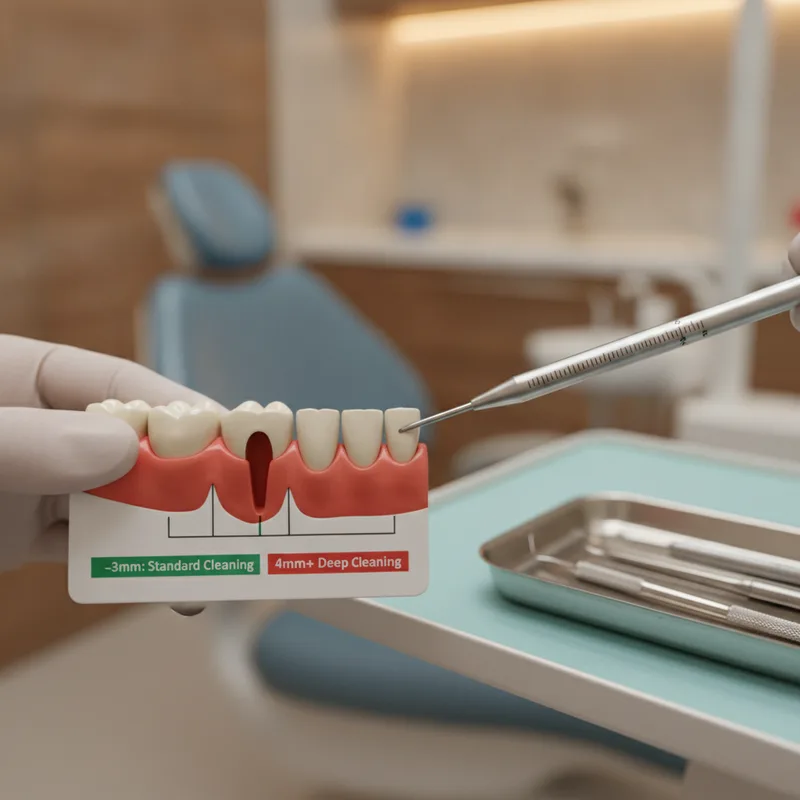
If Dr. Jeong determines you need a deep cleaning rather than a standard prophylaxis, she explains the clinical findings (shows you the pocket measurements and x-rays), presents the cost with insurance estimates, and gives you the treatment plan in writing. No surprise mid-appointment upgrades.
Related: Full deep cleaning guide. → Scaling and Root Planing: Deep Cleaning Explained
It's worth understanding why a deep cleaning costs more and is handled differently. When gum disease has allowed pockets to form below the gumline, bacteria and tartar collect in places a routine cleaning can't reach. Scaling and root planing cleans down into those pockets and smooths the root surfaces so the gums can reattach, which is more time-consuming and is usually done one quadrant of the mouth at a time, often with local anesthesia for comfort.
After a deep cleaning, most patients move onto a periodontal maintenance schedule rather than returning to standard cleanings, typically every three to four months instead of every six. This tighter interval keeps the disease from progressing and is a key reason gum disease is so much cheaper to manage when it's caught early.
What If You Don't Have Insurance?
The self-pay dental cleaning cost in Wylie TX covers the cleaning itself, plus the exam and x-rays at a recall visit, or more for a325 for the full new patient exam and imaging set. Several options bring this cost down.
HSA/FSA accounts cover cleanings with pre-tax dollars. A cleaning paid from an HSA effectively costs less after federal tax savings.
The Willow membership plan bundles two cleanings, exams, and x-rays per year into an annual fee with treatment discounts. For patients who visit twice yearly, this is often cheaper than paying per-visit self-pay rates and provides predictable annual dental costs.
The economic argument for professional cleanings is straightforward: two cleanings per year prevent the cavities, gum disease, and infections that cost far more to treat when caught late. According to the ADA, patients who maintain regular professional cleaning schedules have significantly lower lifetime dental treatment costs than patients who skip cleanings and present with advanced problems. Think of it as the highest-return appointment in dentistry. The visit itself is short and routine, but skipping it for a few years is how a tiny cavity becomes a root canal, or how mild gum inflammation quietly progresses to bone loss. Prevention is almost always less costly, less invasive, and less stressful than treatment.
Your Cleaning Is Probably Fully Covered
Most PPO plans cover two cleanings per year at 100%. Self-pay patients get transparent pricing with HSA/FSA and membership options. Dr. Jeong sees you personally at every visit.
Request an Appointment →The dental cleaning cost in Wylie TX is a modest routine fee for adults and lower for children, covered fully by most insurance plans. New patient visits include additional imaging at no extra insured cost. Dr. Jeong at Willow Family Dentistry determines whether you need a standard cleaning or deep cleaning based on clinical measurements, explains findings before treatment, and never surprise-upgrades mid-appointment. Call (972) 881-0715 to schedule.
The bottom line: a routine cleaning is one of the most affordable and highest-value appointments you can keep, and for most insured patients it costs nothing out of pocket twice a year. Staying consistent with it is the single easiest way to avoid the larger, costlier dental work that neglected cleanings tend to lead to. If you are due for a visit, the team at Willow can confirm what your plan covers before you come in.
Two Cleanings a Year. Fully Covered by Most Insurance.
Your premium already covers it. Preventive care at 100%, no deductible, no copay. Self-pay patients: transparent pricing and membership plan available.
Request an Appointment →Questions about cleaning cost?
Call (972) 881-0715 →Dr. Esther B. Jeong, DDS
DDS · Willow Family Dentistry
Wylie family dentist with 15+ years of experience providing gentle, judgment-free dental care.
Frequently Asked Questions
Was this article helpful?
You may also like


Have a dental question?
Schedule a consultation and get personalized answers from Dr. Jeong.
Call us
(972) 881-0715
Hours
Mon – Thu: 9am – 5pm
Fri: By Appointment
Location
1125 W FM 544, Wylie
Emergency? Same-day appointments available.