Custom Mouthguard for Kids Sports: A Complete Guide
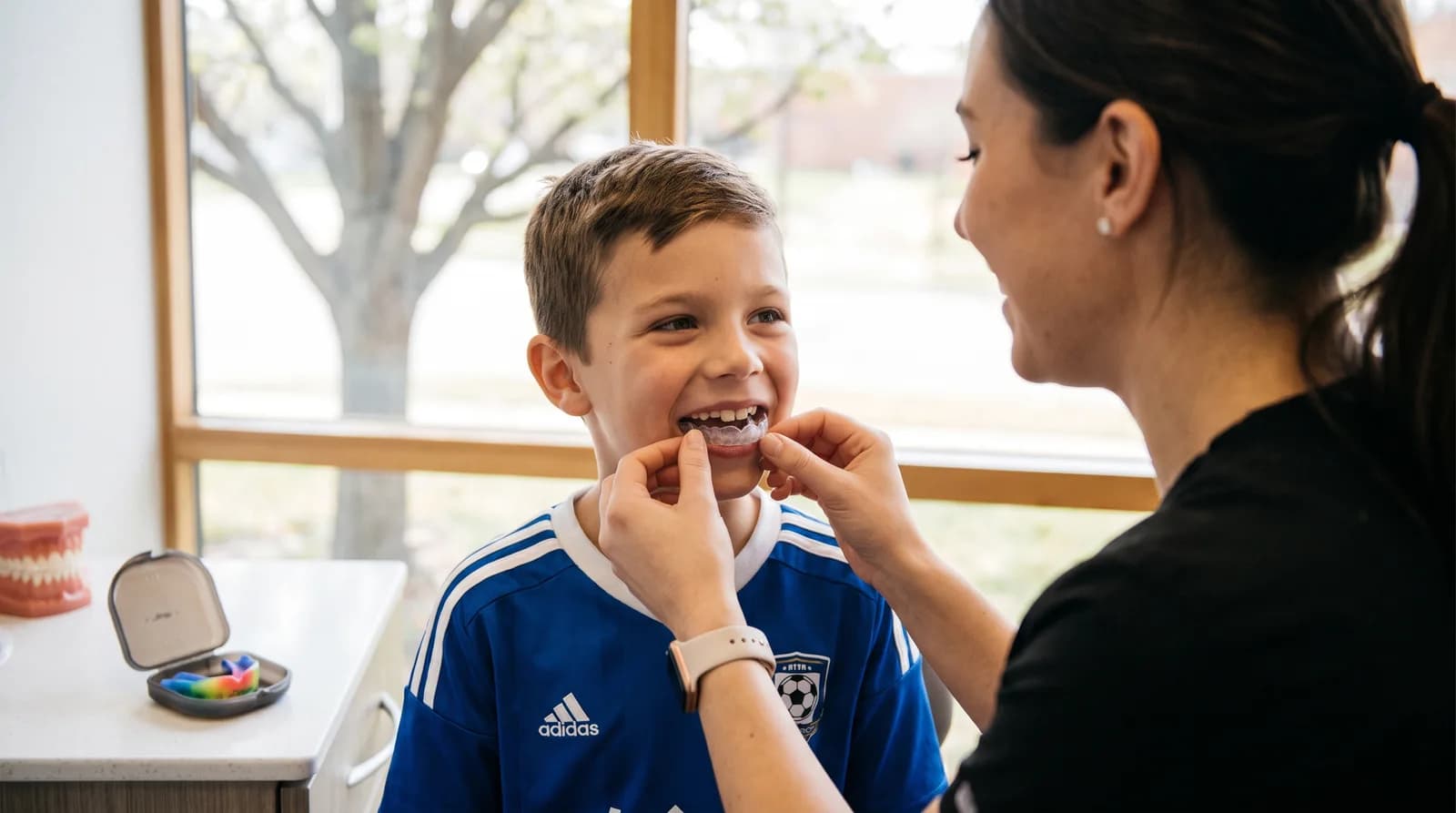
Fall tryouts for football, soccer, and basketball tend to land the same week school starts, which means a custom mouthguard for kids sports question often gets decided in a rush at a sporting goods aisle. It's worth pausing on that decision, since not all mouthguards protect teeth the same way, and a missing guard can quickly turn into an emergency dentist visit.
A dental injury during practice or a scrimmage can happen in the first week of a season just as easily as during a championship game. The gear a child wears to that first practice matters just as much as what they wear later on.
This guide compares stock, boil-and-bite, and custom-fitted guards on fit, breathing, speech, and actual protection. It also covers when to replace one, since a growing child's mouth changes faster than most parents expect. For urgent situations, see this practice's emergency dentist services.
Custom Mouthguard for Kids Sports: Is It Worth the Upgrade?
A custom mouthguard for kids sports is generally worth the upgrade for any child playing contact sports regularly, since it fits precisely, stays in place better, and protects teeth more reliably than a stock or boil-and-bite option.
Not every family needs the custom option right away. A boil-and-bite guard offers a reasonable middle ground for a kid trying a new sport for one season. A custom guard makes more sense once a sport becomes a regular, ongoing commitment.
The real question isn't whether custom is better. It almost always is. The question is whether the better fit and protection matter enough for a specific child's sport and schedule to justify the extra step of getting one made.
According to ADA guidance, a properly fitted mouthguard is one of the most effective, practical ways to prevent dental injuries in youth contact sports. That guidance doesn't specify which type, but fit is consistently the factor that matters most.
Families juggling multiple kids in multiple sports sometimes default to whatever's fastest to grab, which is understandable given a busy fall schedule. Still, a few extra minutes at a dental visit tends to be worth it once the season is actually underway.
Fall Tryouts Are Coming Up Fast
Get a custom mouthguard fitted before the first practice, not after the first injury.
Schedule a Fitting →What Are the Three Types of Mouthguards?
The three main types of mouthguards are stock guards that come pre-formed and ready to wear, boil-and-bite guards that soften in hot water and mold to teeth, and custom guards made from a dental impression.
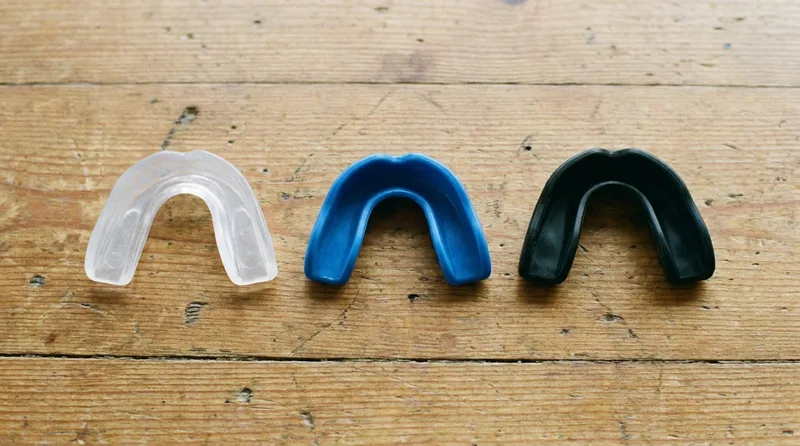
Stock guards are the most widely available option, sold at nearly any sporting goods store. They come in a few generic sizes and aren't shaped to any specific mouth.
- Stock guards: pre-formed, ready to wear immediately, least precise fit.
- Boil-and-bite guards: softened in hot water, then bitten into shape at home.
- Custom guards: made from a dental impression, fitted precisely to one child's teeth.
Each type serves a different level of commitment. None of them are inherently unsafe, but they differ meaningfully in how well they actually protect teeth during real contact.
A lot of families start with a stock guard simply because it's the option available on the shelf the night before a first practice. That's a reasonable emergency solution, but it's worth revisiting once the season is confirmed to be a regular commitment.
| Type | Fit | Speech & Breathing | Protection |
|---|---|---|---|
| Stock | Loose, generic | Bulky, often muffled | Basic |
| Boil-and-bite | Moderate, semi-custom | Better, still bulky | Good |
| Custom | Precise, individual | Minimal interference | Best |
How Do Stock, Boil-and-Bite, and Custom Guards Compare on Fit?
Stock guards fit loosely and require constant biting to hold in place, boil-and-bite guards fit better but still shift during play, and custom guards fit precisely enough that a child barely notices wearing one.
A loose-fitting guard tends to fall out at exactly the wrong moment, usually during the play where it's needed most. Kids often stop wearing it consistently once it becomes annoying enough to fuss with between plays.
A custom guard is molded from an actual impression of a child's teeth, so it stays seated without constant clenching. That difference alone makes kids far more likely to keep it in for an entire game rather than pulling it out on the sideline.
Coaches and referees notice this pattern too. A kid constantly readjusting or removing a guard between plays is a kid who's effectively unprotected for a meaningful chunk of actual game time.
Parents sometimes assume a slightly loose fit is fine as long as the guard technically stays in the mouth. In practice, a loose guard shifts under impact exactly when a tight, stable fit matters most.
Does a Custom Mouthguard Affect Breathing or Speech?
Custom mouthguards interfere far less with breathing and speech than stock or boil-and-bite guards, since the thinner, more precise fit doesn't need extra bulk to stay in place the way generic guards do.
Bulkier stock guards often force a child to breathe more through the mouth, which becomes noticeably uncomfortable during intense physical activity. Coaches sometimes notice players struggling to communicate clearly on the field simply because of an ill-fitting guard.
Custom guards are thinner exactly where extra material isn't structurally needed, and thicker only where impact protection actually matters. That precision is part of why kids who switch to a custom guard rarely go back to a stock one afterward.
Clear communication matters more in some sports than others. A quarterback calling a play or a point guard directing teammates needs a guard that doesn't muffle speech, which is a meaningful practical reason custom guards get chosen for those specific positions.
Some kids simply refuse to wear a bulky guard consistently, no matter how many reminders a parent or coach gives. A thinner, better-fitting custom guard solves that compliance problem directly, since there's less reason to want it out of the mouth in the first place.
A Judgment-Free Team for Nervous Kids
Dr. Jeong's team keeps impressions quick and comfortable, even for anxious first-timers.
Meet Dr. Jeong →Which Type Actually Offers the Best Protection?
Custom mouthguards offer the best protection because they stay properly positioned during actual contact, while a loose stock guard can shift out of place at the exact moment of an impact, reducing how much protection it provides.

A mouthguard only protects a tooth it's actually covering at the moment of impact. A guard that's shifted or partially fallen out doesn't help nearly as much as one seated correctly, regardless of how thick or well-marketed the material is.
A knocked-out tooth can be saved if reimplanted within about 30 minutes, according to the ADA. A well-fitted mouthguard is one of the simplest ways to prevent that emergency from happening in the first place, rather than managing it after the fact. Regular dental visits can catch about 80% of oral health issues before they become serious, according to the ADA, and a mouthguard check fits naturally into that same preventive mindset.
Protection also depends on consistency, not just material quality. A guard a child actually keeps in for the whole practice protects far better than a slightly thicker guard that keeps getting pulled out because it feels uncomfortable.
When Should My Child Start Wearing a Mouthguard for Fall Sports?
Kids should start wearing a mouthguard as soon as fall sports tryouts begin, since injuries can happen during practice and conditioning just as easily as during an actual game or scrimmage.
Football, soccer, and basketball tryouts in Wylie ISD tend to start the same week classes resume, which means there's often no gap between the first day of school and the first day of real contact practice.
Waiting until the first official game to start wearing a mouthguard skips weeks of practice contact where injuries happen just as often. Getting fitted before tryouts begin means a child is protected from day one, not just game day.
Scheduling a fitting during the same back-to-school window as a dental checkup tends to be the easiest way to avoid a last-minute scramble the night before the first practice.
Multi-sport kids benefit even more from planning ahead, since a single custom guard often works across football, soccer, and basketball without needing a separate guard for each season. Patients who keep up with routine preventive care are roughly 60% less likely to lose teeth over time, according to the Journal of Dental Research, and a well-fitted mouthguard is part of that same long-term pattern.
When Should We Replace a Mouthguard?
A mouthguard should be replaced whenever it no longer fits properly, shows visible wear or tears, or after a child loses a baby tooth or gains a new permanent one, since growing mouths change shape quickly.
Kids in the elementary and middle school years are losing and gaining teeth constantly. A mouthguard fitted perfectly in the spring can feel noticeably loose by the start of fall sports just months later.
- Visible wear: tears, thinning, or holes mean the guard no longer protects reliably.
- Loose fit: a guard that shifts or falls out easily has likely been outgrown.
- New teeth: losing or gaining a tooth changes the mouth's shape enough to need a refit.
Checking fit at the start of every new season, rather than assuming last year's guard still works, catches most of these changes before a season starts rather than partway through it.
Kids in braces need especially frequent refitting, since orthodontic movement changes tooth position gradually throughout treatment. A guard that fit well at the start of treatment may need adjusting well before braces come off entirely. According to Mayo Clinic's general guidance on dental care, regular fit checks are especially important during active orthodontic treatment.
How Do I Get a Custom Mouthguard for My Child at Willow Family Dentistry?
Getting a custom mouthguard at Willow Family Dentistry starts with a quick dental impression, which then gets sent out to create a guard fitted specifically to your child's mouth, usually ready within one to two weeks.

The appointment itself takes only a few minutes. There's no discomfort involved, just a brief impression taken in the office. Most kids handle it easily, even ones who feel nervous about other dental procedures.
- Schedule an appointment before fall tryouts begin, ideally at the same visit as a back-to-school checkup.
- Have an impression taken; this takes only a few minutes.
- Pick up the finished guard once it's ready, usually within one to two weeks.
- Check the fit again at the start of every new season.
Dr. Jeong reviews fit and comfort at pickup, so any small adjustment gets handled right away rather than after a first uncomfortable practice. Most kids only need one visit to get the process started.
For more on how sports guards fit into overall preventive care, see this practice's pediatric dentistry services, and the back to school dental checkup guide for scheduling both at once.
The short version: a custom mouthguard for kids sports offers meaningfully better fit, breathing, speech, and protection than a stock or boil-and-bite option, and it's worth having in place before fall tryouts begin, not after the first injury happens.
Results may vary. Please consult with Dr. Jeong for personalized treatment recommendations.
If last year's mouthguard has been sitting in a gym bag since spring, it's worth checking the fit before the next practice, not after. A quick check now is far simpler than an emergency visit later in the season.
Have a question about fit or timing?
Children already wearing braces need a mouthguard shaped to fit over the brackets, which the team fits as part of orthodontic care for teens.
Contact Us →Dr. Esther B. Jeong, DDS
DDS · Willow Family Dentistry
Wylie family dentist with 15+ years of experience providing gentle, judgment-free dental care.
Frequently Asked Questions
Was this article helpful?
You may also like


Have a dental question?
Schedule a consultation and get personalized answers from Dr. Jeong.
Call us
(972) 881-0715
Hours
Mon – Thu: 9am – 5pm
Fri: By Appointment
Location
1125 W FM 544, Wylie
Emergency? Same-day appointments available.